body.postid-4251 .blog-single .post-thumbnail-image{display:none}
body.postid-4251 .blog-single .post-head{background:linear-gradient(45deg,rgba(92,0,255,.55),rgba(255,114,0,.45)),url(“https://paragym.com/wp-content/uploads/2023/01/Acrobatics-2-5-min-1200×800.jpg”) center/cover no-repeat;border-bottom-right-radius:clamp(60px,12vw,220px);padding:clamp(130px,15vw,200px) 0 clamp(44px,6vw,80px);margin-bottom:8px}
body.postid-4251 .blog-single .post-content-box{max-width:1140px;margin:0 auto;padding:0 15px;color:#fff}
body.postid-4251 .blog-single .post-title{font-family:Poppins,sans-serif;font-weight:500;color:#fff;font-size:clamp(32px,5vw,64px);line-height:1.08;margin:0 0 14px;max-width:980px;text-shadow:0 2px 12px rgba(0,0,0,.25)}
body.postid-4251 .blog-single .post-head-excerpt{display:none}
body.postid-4251 .blog-single .post-head-date{color:#fff;opacity:.9;font-size:15px}
.page-banner #el-882f07f6{margin-bottom:0!important;padding-bottom:clamp(36px,5vw,64px)}
.pg-draft{padding:56px 0 24px;font-size:17px;line-height:1.7}
.pg-draft h2{font-family:Poppins,sans-serif;font-weight:500;font-size:clamp(28px,3.4vw,42px);line-height:1.2;margin:56px 0 18px}
.pg-draft h3{font-family:Poppins,sans-serif;font-weight:500;font-size:clamp(21px,2.2vw,26px);line-height:1.3;margin:32px 0 10px}
.pg-draft p,.pg-draft li{max-width:860px}
.pg-draft ul{padding-left:1.2em;margin:0 0 18px}.pg-draft li{margin-bottom:6px}
.pg-draft a:not(.btn){color:#3a7bec;text-decoration:underline}
.pg-draft .pg-img{margin:36px 0;max-width:960px}
.pg-draft .pg-img img{width:100%;height:auto;max-height:560px;object-fit:cover;border-radius:24px;display:block}
.pg-draft .pg-cta{display:flex;flex-wrap:wrap;gap:14px;align-items:center;margin:28px 0 8px}
.pg-draft .pg-cta-box{background:#f3f6fd;border-radius:24px;padding:28px 32px;margin:48px 0}
.pg-draft .pg-cta-box h2{margin-top:0}
@media(max-width:767px){.pg-draft{padding-top:32px;font-size:16px}.pg-draft .pg-img{margin:24px 0}.pg-draft .pg-cta-box{padding:22px 20px}}
The backflip is probably the acrobatic move adults want most. It impresses, it’s scary, and many people think it’s only for gymnasts who started as kids. Not true: with a structured progression, good coaching and some patience, many adults learn their backflip. This guide covers the steps, the prerequisites and the mistakes to avoid.
Important: this guide explains the progression; it does not replace a coach. Don’t attempt a backflip alone, without a spotter or a suitable surface.
Why is the backflip so hard for adults?
Physically, a backflip mainly requires three things: a good vertical jump, a fast backward rotation (the tuck) and the ability to stay oriented upside down. For adults, the real challenge is often mental: the brain doesn’t like tipping backwards without seeing where it’s going. That’s why a progression that builds confidence step by step matters as much as strength.

Prerequisites
Before working on the backflip, it helps to be comfortable with:
- forward and backward rolls;
- a vertical tuck jump (knees to chest) with a controlled landing;
- a short inverted hold (against a wall, for example);
- a strong core and prepared wrists and shoulders.
If you’re not there yet, start with Foundations or Acrobasics, which train the fundamental movement families the flip is built on. To find your level, see Levels & Curriculum or take the placement quiz.
The step-by-step progression
Here is, broadly, how a backflip is built. Each step must be solid before moving on.
1. Jump and stick
It all starts with a powerful vertical jump, arms driving up, body tight, followed by a stable landing. Many adults “throw back” too early; learning to jump up first is the key to a safe backflip.
2. The tuck
Next you learn to pull your knees to your chest quickly at the top of the jump, keeping your chin neutral. It’s practised on the floor first, then jumping, often from a raised or springy surface.
3. Assisted rotation
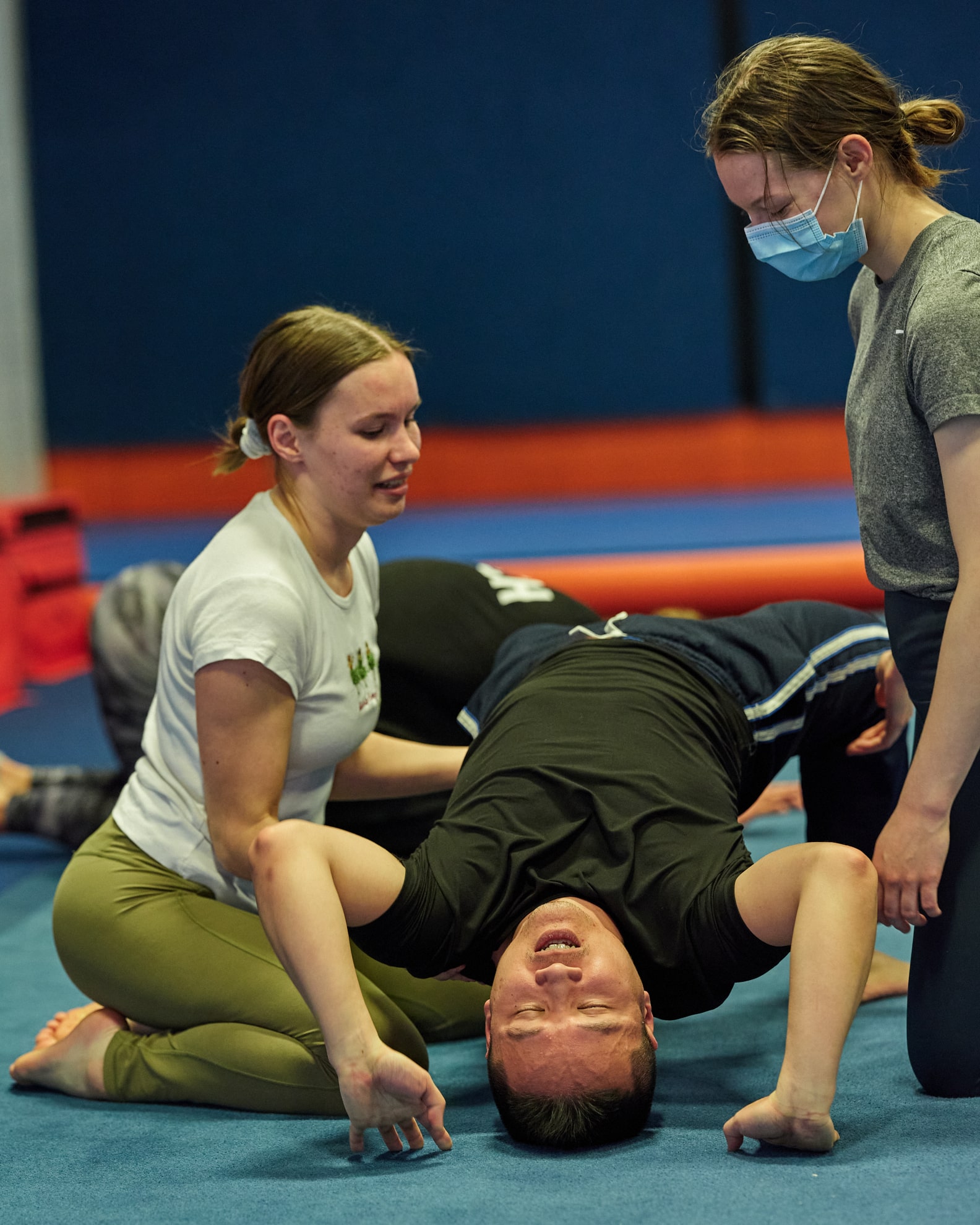
Here the coach or a trained teammate spots you. The rotation is first done with lots of help, on thick mats or an air floor, then the help is gradually reduced. This is also when you learn to spot the floor during the rotation.
4. Reduce help and mats
Little by little the aids come off: thinner mats, lighter spotting, firmer surface. The final goal is a consistent backflip on the floor, without a spotter and without a mat.
How long does it take?
It depends heavily on your starting point, your consistency and how you handle fear. Rather than promise a timeline, we prefer to structure the learning. That’s the idea behind Backflip to the Future: a 12-week program with one 1.5-hour group class per week, up to 2 group open practices per week, a progressive training plan and access to video analysis.
- Level 1 – Backflip: for people who don’t yet have a consistent solo backflip. Goal: a floor backflip without a spotter or mat.
- Level 2 – Roundoff-back / Back handspring: for those who already have a consistent backflip. Goal: backflip on the tumbling track, round-off backflip and back handspring on the air floor, independently.
Participants train in teams of 3 to help each other, including with spotting. Upcoming dates and registration options are on the program page.
Most common mistakes
- Throwing the head back: it kills height and can land you on your neck. Jump first, rotate second.
- Jumping backwards instead of up: the flip becomes low and flat.
- Opening too early: leaving the tuck before rotating lands you on your knees or seat.
- Skipping steps: moving to the floor too soon, without a spotter, is the most common cause of falls.
- Training tired: end-of-session attempts when exhausted are the riskiest.
Can you learn a backflip at 30, 40 or 50?
There’s no fixed age limit; what matters is your fitness, having no injuries (especially neck, back and knees) and patience. If you have any medical doubt, talk to a health professional first. A personalized consultation with one of our coaches can also assess your movement, weaknesses and a realistic timeline.
After the backflip
Once you have it, many doors open: round-off backflip, back handspring, combinations, parkour or tricking. Core Acrobatics trains Paragym’s cornerstone flips and Acro-Obstacles integrates them into obstacle setups. See also Adult Acrobatics Classes in Montreal and Parkour Classes in Montreal.

In short
An adult backflip is a realistic goal if you respect the steps: solid basics, vertical jump, tuck, assisted rotation, then gradually removing aids. Train with coaches who know how to spot, and train regularly.
Ready? Discover Backflip to the Future or check the class schedule. Paragym, 5465 Rue de Bordeaux, Montreal · (438) 600-2605.
Ready to give it a try?
Check the schedule, pick your class and come move with us at 5465 Rue de Bordeaux.
Frequently asked questions
Can I learn a backflip alone at home?
We strongly advise against it. A backflip should be learned with a qualified spotter and suitable surfaces; a rotation error can mean landing on your head or neck.
Do I need to be very strong?
Mostly you need a good vertical jump, a fast tuck and a strong core. These are developed in Foundations and Acrobasics.
What’s included in Backflip to the Future?
A 12-week program with one 1.5-hour group class per week, up to 2 group open practices per week, a structured plan and access to video analysis.
{“@context”: “https://schema.org”, “@type”: “FAQPage”, “mainEntity”: [{“@type”: “Question”, “name”: “Can I learn a backflip alone at home?”, “acceptedAnswer”: {“@type”: “Answer”, “text”: “We strongly advise against it. A backflip should be learned with a qualified spotter and suitable surfaces; a rotation error can mean landing on your head or neck.”}}, {“@type”: “Question”, “name”: “Do I need to be very strong?”, “acceptedAnswer”: {“@type”: “Answer”, “text”: “Mostly you need a good vertical jump, a fast tuck and a strong core. These are developed in Foundations and Acrobasics.”}}, {“@type”: “Question”, “name”: “What’s included in Backflip to the Future?”, “acceptedAnswer”: {“@type”: “Answer”, “text”: “A 12-week program with one 1.5-hour group class per week, up to 2 group open practices per week, a structured plan and access to video analysis.”}}]}